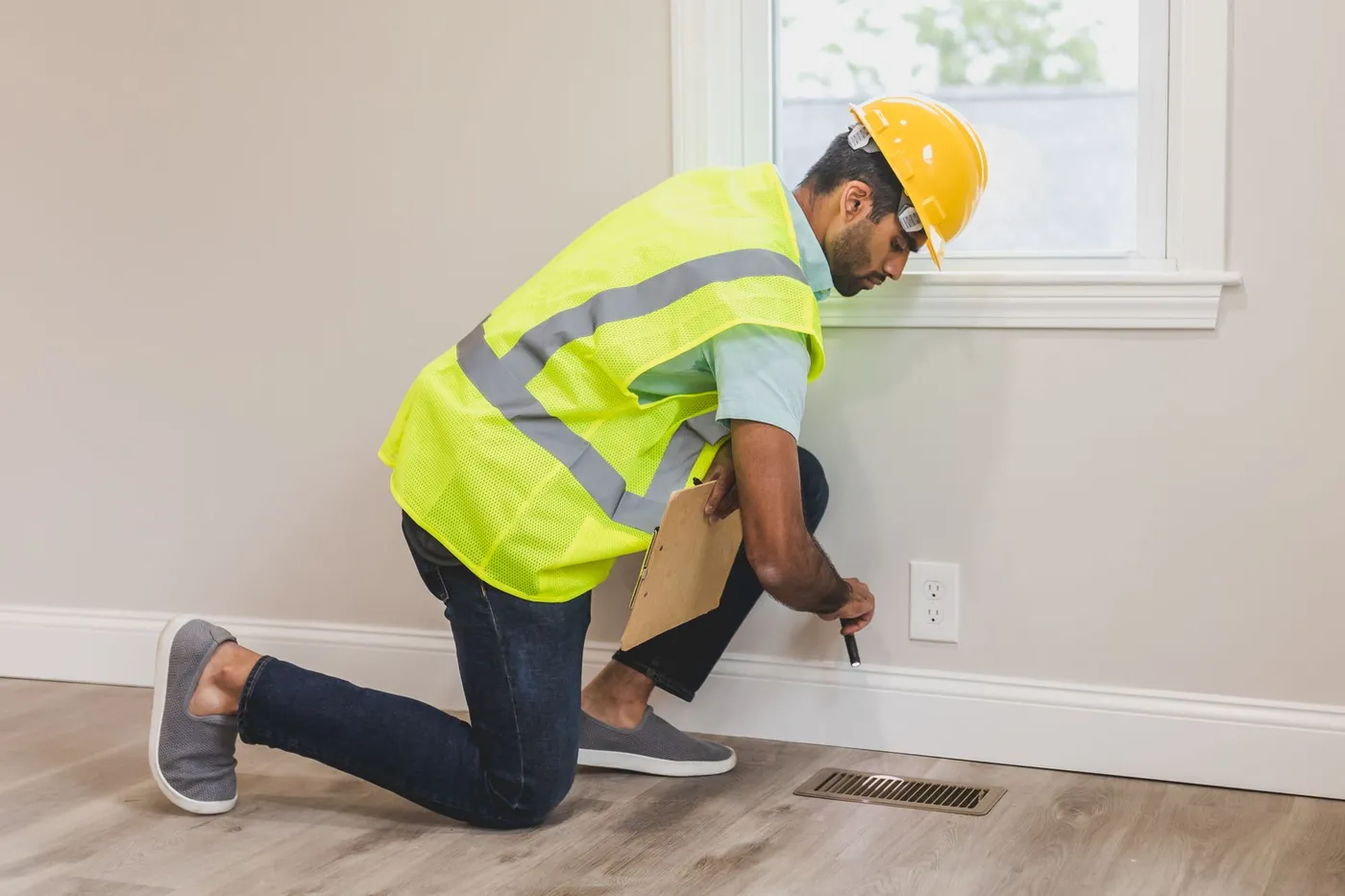
Real Estate Testing Follows a Different Protocol
A homeowner testing out of curiosity can put a kit on a shelf and mail it in. A test that is going to sit in a transaction file and potentially move money has to be defensible, and EPA lays out specific options for that situation.
For a real estate transaction, EPA recommends one of three approaches: two passive tests placed simultaneously side by side, two passive tests run sequentially in the same location, or a continuous monitor. Whichever you use, the minimum exposure is 48 hours, and some devices require longer.
The reason for the redundancy is straightforward. A single passive detector produces one number with no way to check it. Two detectors that agree are hard to argue with, and a continuous monitor produces an hour-by-hour record that also shows whether the house was actually kept closed. In a transaction, that record is frequently worth more than the average it reports.
Closed-House Conditions, and Why Deals Die Over Them
Radon levels indoors depend heavily on ventilation, which means an open window can produce a passing number on a house that would otherwise fail. EPA's protocol closes that loophole, and the requirements are specific:
- All windows closed for the duration of the test
- Doors closed except for normal entry and exit
- No fans or machines running that bring in outside air — whole-house fans, window units in vent mode, attic fans
- At least 12 hours of closure before the test starts, for any short-term test under four days. Indoor levels reach a steady state roughly 12 hours after a house is closed up, so starting sooner measures the ventilation, not the house.
In an occupied home mid-sale, this is where things go wrong. A seller airs the place out before a showing. A stager props the back door. An agent runs the AC fan on continuous. Any one of those can invalidate a test that someone is waiting on, and discovering it on day three of a ten-day inspection window is a real problem.
We put the requirements in writing to every party before placement, and on continuous monitor tests the data log usually shows us if conditions broke.
Where the Detector Goes
Placement is not arbitrary, and a test placed wrong is a test that gets challenged.
The device goes on the lowest level of the home that could be used regularly. Not the lowest level currently in use, the lowest one that could be. A finished room that the current owner uses for storage still counts, because the buyer may use it as a bedroom.
From there: at least 20 inches above the floor, away from drafts, away from heat sources, away from high humidity, and away from exterior walls. Not in a closet, not in a hallway, not in a kitchen or bathroom. Each of those either skews the reading or sits outside the breathing zone the number is supposed to represent.
On a Jacksonville slab home the lowest lived-in level is usually the main floor, which simplifies things. Homes with a finished space over a crawl space, or any below-grade room, need more thought about which level actually governs.
Who Should Place the Test
Anyone can buy a kit. In a transaction, the question is not who can run a test but whose test both sides will accept.
A test placed and retrieved by a third party, with documented placement, tamper-evident handling, and a written report, is difficult for either side to dispute. A test the seller ran themselves is not, regardless of whether they did it correctly, because the buyer has no way to confirm the conditions were held.
This is not an accusation against sellers. It is that a result nobody can verify creates an argument at exactly the moment when neither party wants one. Paying for an independent test is cheap compared with an inspection period spent litigating a number.
If the Number Comes Back High
EPA recommends fixing a home at 4 pCi/L or higher. A result at or above that does not have to kill the deal, and usually does not.
What typically happens is one of three things. The seller mitigates before closing, which is common when the timeline allows. The seller credits the buyer at closing for the cost of mitigation, which is common when it does not. Or the price gets adjusted and the buyer handles it after taking possession.
What makes this easier than most inspection findings is that mitigation on a slab home is a bounded, well-understood cost. Once someone has walked the house and quoted a system, both sides are negotiating against a real number rather than an estimate range. We are happy to provide that quote during the inspection period so the parties have something concrete to work with.
If the buyer proceeds and a system goes in, insist on a post-mitigation test in writing. A system that was installed but never verified is a question mark handed to whoever sells the house next.
Timeline and Cost
Plan on three days from the call to the result: place on day one, minimum 48 hours of exposure, retrieve and report on day three. Add the 12 hours of closed-house conditions before placement and the practical window is closer to four days end to end.
That is the single most important scheduling fact for anyone under contract. Inspection periods here are frequently seven to ten days, and radon is often the last thing anyone thinks of. Call when the contract is signed, not when the window is closing.
What affects the cost:
- Test method. A continuous monitor costs more than paired passive detectors and gives you an hourly data log, which is worth it when the house is occupied or the parties are already tense.
- Number of levels or units tested. Multi-level homes and duplexes need more than one placement.
- Turnaround. Standard reporting is same-day on retrieval; nothing shortens the 48-hour exposure minimum.
- Whether a mitigation quote is included. We will price a system during the same visit at no extra charge if the result warrants it.
Frequently Asked Questions
How fast can you get a real estate radon test done?
The test itself needs a minimum of 48 hours under closed-house conditions, plus 12 hours of closure before it starts. Practically that means we place on day one and pick up on day three, with results the same day we retrieve. If your inspection period is tight, call as soon as you are under contract rather than at the end of the window.
Can the seller run the test themselves?
They can, but a buyer has no way to verify the conditions were held, and that is exactly the kind of ambiguity that blows up late in a deal. A third-party test with documented placement, tamper-evident handling, and a written report removes the argument. It is a small cost relative to what a disputed result costs in time.
What happens if the result comes back at 4 pCi/L or higher?
EPA recommends fixing at 4 pCi/L or above, and in practice the result becomes a negotiation item like any other inspection finding. Common outcomes are a seller-paid mitigation before closing, a credit at closing, or a price adjustment. The useful thing is that mitigation is a known, bounded cost on a slab home, so the number is easy to agree on once someone has quoted it.
Does an existing radon system mean the house is fine?
It means someone found a problem and addressed it, which is a good sign, not a guarantee. Fans last 8 to 12 years and they do fail silently. Ask for the original post-mitigation test result and the install date, and test the house regardless. A working system is an asset; an unverified one is just PVC on the wall.
Under Contract? Call Today.
The test needs 48 hours minimum. Call when the contract is signed, not when the inspection window is closing.
Call (904) 516-8985